Spine
A term spanning biology, medicine, arts, and more.

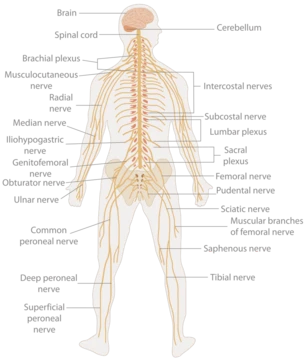
Spine or spinal is a term with multiple meanings across science, medicine, arts, entertainment, and other fields. It appears in biology as the spinal column, dendritic spines, and needle-like structures in plants and animals, as well as in molecular biology as a method for detecting protein interactions. In medicine, it refers to spinal anaesthesia and a UK NHS service called The Spine.
- field
- Multidisciplinary (biology, medicine, arts, entertainment, bookbinding, archery)
- known_for
- Spinal column, dendritic spine, thorns/spines/prickles, spinal anaesthesia, The Spine (album, film, video game, building, journal, bookbinding edge, arrow shaft stiffness)
Lore & Background
In biology, spine refers to the spinal column (backbone), dendritic spines on neurons, and needle-like structures in plants (thorns, spines, prickles) and animals (zoology). In molecular biology, SPINE stands for strep–protein interaction experiment, a method for detecting protein interactions. In medicine, spinal anaesthesia (or 'a spinal') is an injection through a fine needle, and The Spine is a set of national services within the UK NHS Connecting for Health.
Reader's Guide
The term 'spine' appears across diverse domains, reflecting its broad utility. In science, it describes anatomical and structural features from the backbone to cellular protrusions and defensive plant structures. In medicine, it denotes a specific anaesthetic technique and a healthcare IT service. The arts and entertainment use 'spine' for albums, films, video games, novels, sculptures, and buildings. Fictional entities include a character from Killer Instinct, a demon in the Demonata saga, a mountain chain in The Inheritance Cycle, and a singing automaton in Steam Powered Giraffe. Periodicals include Spine (a bi-weekly peer-reviewed journal of spine surgery) and The Spine Journal (bi-monthly). Other uses include bookbinding (the closed edge of a book) and archery (a measure of arrow shaft stiffness). The term also appears in anatomical landmarks such as the anterior inferior iliac spine, ischial spine, mental spine, nasal spines, spine of scapula, and spine of sphenoid bone.
Did You Know?
- Spine (molecular biology) is a method for detecting protein interactions, standing for strep–protein interaction experiment.
- The Spine is a set of national services within the UK NHS Connecting for Health.
- Spine (bookbinding) is the closed edge of a book along which the pages are bound.
- Spine, in archery, is a measure of stiffness of an arrow shaft.
More in Human Anatomy 25-38
Elsewhere in the Human Anatomy universe
Spotted an error? Know more?
This is a living reference — every entry is fact-audited, and reader corrections feed straight into our audit queue. Suggest an edit · See this site's audit record