Ganglion
Groups of neuron cell bodies in the peripheral nervous system.

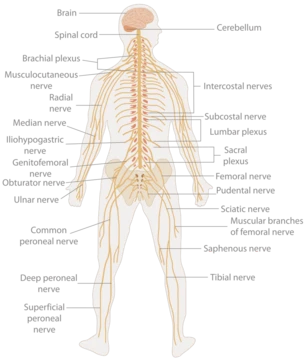
A ganglion (pl.: ganglia) is a group of neuron cell bodies in the peripheral nervous system. In the somatic nervous system, this includes dorsal root ganglia and trigeminal ganglia among a few others. In the autonomic nervous system, there are both sympathetic and parasympathetic ganglia which contain the cell bodies of postganglionic sympathetic and parasympathetic neurons respectively. Ganglia provide relay points and intermediary connections between different neurological structures in the body, such as the peripheral and central nervous systems.
- field
- Neuroanatomy
- known_for
- Group of neuron cell bodies in the peripheral nervous system; relay points between peripheral and central nervous systems
Lore & Background
Ganglia are primarily made up of somata and dendritic structures, which are bundled or connected. Ganglia often interconnect with other ganglia to form a complex system of ganglia known as a plexus. Among vertebrates there are three major groups of ganglia: dorsal root ganglia (spinal ganglia) containing cell bodies of sensory neurons; cranial nerve ganglia containing cell bodies of cranial nerve neurons; and autonomic ganglia containing cell bodies of autonomic nerves. In the autonomic nervous system, fibers from the central nervous system to the ganglia are known as preganglionic fibers, while those from the ganglia to the effector organ are called postganglionic fibers.
Reader's Guide
The term 'ganglion' is restricted to the peripheral nervous system, though this postdates the naming of brain structures such as the basal ganglia, which remains a historical artifact in vertebrate terminology. The basal ganglia are a group of nuclei in the brain interconnected with the cerebral cortex, thalamus, and brainstem, associated with motor control, cognition, emotions, and learning. Partly due to this ambiguity, the Terminologia Anatomica recommends using the term 'basal nuclei' instead of 'basal ganglia', but this usage has not been generally adopted. Among invertebrates the restriction is disregarded; for example, the main part of the insect brain is called the cerebral ganglion. A pseudoganglion is a localized thickening of a nerve that has the appearance of a ganglion but only has nerve fibers and no nerve cell bodies; pseudoganglia are found in the teres minor muscle and radial nerve.
Did You Know?
- A pseudoganglion looks like a ganglion but only has nerve fibers and few nerve cell bodies.
- Pseudoganglia are found in the teres minor muscle and radial nerve.
- The Terminologia Anatomica recommends using 'basal nuclei' instead of 'basal ganglia', but this has not been generally adopted.
- Among invertebrates, the main part of the insect brain is called the cerebral ganglion.
More in Human Anatomy 1-24
Elsewhere in the Human Anatomy universe
Spotted an error? Know more?
This is a living reference — every entry is fact-audited, and reader corrections feed straight into our audit queue. Suggest an edit · See this site's audit record