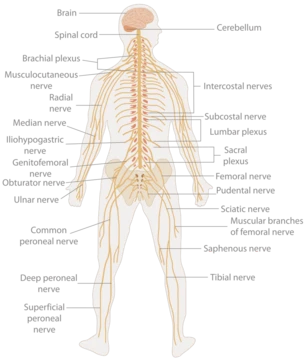
Human leg
The human leg is adapted for efficient bipedal locomotion.

The human leg is the lower limb of the human body, including the thigh, knee, lower leg, ankle, foot, or sometimes the hip or buttock region. It contains thirty bones, with the major bones being the femur, tibia, and fibula. The leg is used for standing, many forms of human movement, and recreation such as dancing, and constitutes a significant portion of a person's mass. Evolution has led to the human leg's development into a mechanism specifically adapted for efficient bipedal gait, with humans having exceptionally long and powerful legs compared to other primates.
- Bones per leg
- 30
- Major bones
- Femur, tibia, fibula
- Key adaptation
- Efficient bipedal gait
Lore & Background
The major bones of the leg are the femur, tibia, and fibula, all long bones. The patella is a sesamoid bone in front of the knee. Pathological changes produce coxa vara (small angle) or coxa valga (large angle). The torsion angle of the femoral neck allows hip flexion movements to be transposed into rotary movements of the femoral head. Abnormal torsion angles result in the limb turning inward or outward, reducing mobility range.
Reader's Guide
The human leg is significant as a specialized structure for bipedal locomotion, a defining characteristic of humans. Its evolution has produced long, powerful legs with a unique arrangement of bones, joints, and muscles that enable efficient upright walking and running. The leg's anatomy includes thirty bones, with the femur, tibia, and fibula as major components, and the patella as the largest sesamoid bone. The mechanical axis of the leg, the Mikulicz line, defines normal alignment, and deviations such as genu varum or genu valgum impose unbalanced loads on joints. The leg's muscles, particularly the gluteal muscles, knee extensors, and calf muscles, are adapted for bipedalism. The hip muscles, including the iliopsoas, gluteus maximus, and deep glutei, control movements such as flexion, extension, rotation, abduction, and adduction. The leg's development has also influenced the body's center of gravity, internal organ placement, and the vertebral column's shock-absorbing function. Understanding the human leg is essential for fields such as anatomy, biomechanics, orthopedics, and evolutionary biology, as it underpins human mobility and physical activity.
Did You Know?
- The human leg contains thirty bones, with the major bones being the femur, tibia, and fibula.
- The psoas minor muscle is present in only about 50% of subjects.
More in Human Anatomy 25-38
Elsewhere in the Human Anatomy universe
Spotted an error? Know more?
This is a living reference — every entry is fact-audited, and reader corrections feed straight into our audit queue. Suggest an edit · See this site's audit record