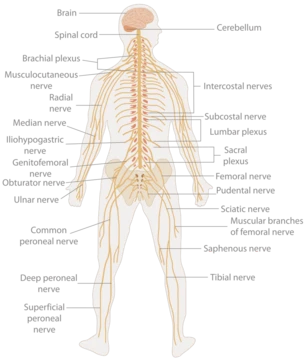
Human brain
Central organ of the nervous system, controlling body activities.

The human brain is the central organ of the nervous system, and with the spinal cord, comprises the central nervous system. It consists of the cerebrum, the brainstem and the cerebellum. The brain controls most of the activities of the body, processing, integrating, and coordinating the information it receives from the sensory nervous system.
- average weight
- 1.2–1.4 kg (2.6–3.1 lb)
- neuron count
- more than 86 billion
- cortex thickness
- 2 to 4 mm
- number of lobes
- four main lobes (frontal, parietal, temporal, occipital)
Lore & Background
The human brain is protected by the skull, suspended in cerebrospinal fluid, and isolated from the bloodstream by the blood–brain barrier. It is susceptible to damage, disease, and infection, including trauma, stroke, degenerative disorders such as Parkinson's disease and Alzheimer's disease, and psychiatric conditions like schizophrenia and clinical depression. The brain can also be the site of tumours, mostly originating from other sites in the body.
Reader's Guide
The study of the anatomy of the brain is neuroanatomy, while the study of its function is neuroscience. Numerous techniques are used to study the brain, including microscopic examination of animal specimens, medical imaging technologies such as functional neuroimaging, and electroencephalography (EEG) recordings. The medical history of people with brain injury has provided insight into the function of each part of the brain. Neuroscience research has expanded considerably, and research is ongoing. In culture, the philosophy of mind has for centuries attempted to address the question of the nature of consciousness and the mind–body problem. The pseudoscience of phrenology attempted to localise personality attributes to regions of the cortex in the 19th century.
Did You Know?
- The human brain weighs about 2% of total body weight.
- The cerebrum is divided into four lobes: frontal, parietal, temporal, and occipital.
- The brain contains more than 86 billion neurons and a similar number of other cells.
- The brain is protected by the skull, cerebrospinal fluid, and the blood–brain barrier.
Grand Architecture of the Cerebrum
The cerebrum dominates the brain's layout, forming the largest single component and draping over every other structure beneath it. It is built from two roughly mirror-image hemispheres, each containing a dense inner core of white matter wrapped in an outer shell of grey matter known as the cerebral cortex. That cortex is stratified: the outer neocortex carries six distinct neuronal layers, while the inner allocortex holds only three or four. The surface of each hemisphere is further partitioned into four principal lobes—the frontal, parietal, temporal, and occipital—each tied to characteristic roles. The frontal lobe underpins executive capacities such as planning, self-regulation, and abstract reasoning, whereas the occipital lobe is devoted almost entirely to visual processing. Although the two hemispheres share a broadly similar shape and functional repertoire, certain abilities lean to one side: language tends to localize in the left hemisphere, while visual-spatial processing favors the right. The two halves stay in constant dialogue through commissural tracts, the most prominent being the corpus callosum. In an adult, the whole organ tips the scale at roughly 1.2 to 1.4 kilograms, about two percent of total body mass, and its living tissue has a soft, gel-like texture often compared to tofu.
Cellular Machinery and Neural Networks
Beneath the brain's macroscopic architecture lies an extraordinary cellular ecosystem. The organ houses more than 86 billion neurons alongside a roughly equal population of supportive glial cells, and it is the interconnections among those neurons that make all brain activity possible. When a nerve impulse reaches a neuron, the cell releases chemical messengers called neurotransmitters into the gap with its neighbor, and this process of neurotransmission drives the entire circuitry. Neurons link together to form pathways, circuits, and vast network systems that span the whole organ. Beneath the cortical surface, a rich collection of subcortical structures supports these networks. The thalamus, hypothalamus, pituitary gland, and pineal gland sit among the deeper tissue, while the limbic system contributes the amygdalae and hippocampi—both present in pairs, as are most structures that do not lie on the brain's midplane. The basal ganglia nuclei, the claustrum, and basal forebrain structures round out this inner landscape. Cerebrospinal fluid is produced and circulated within a ventricular system of four interconnected chambers, bathing the tissue and helping maintain its internal environment.
Shielded Yet Vulnerable
The brain enjoys multiple layers of protection. It is cradled inside the rigid vault of the skull, suspended in a cushion of cerebrospinal fluid that flows through the subarachnoid space between the arachnoid and pia mater membranes, and walled off from the general bloodstream by the blood–brain barrier, of which the glia limitans—the outermost basement membrane of the pia mater—forms a critical component. Three meningeal layers, the tough dura mater, the middle arachnoid mater, and the delicate pia mater, wrap the cerebrum, brainstem, cerebellum, and spinal cord. Despite these defenses, the brain remains remarkably vulnerable. Physical trauma and strokes—episodes in which blood supply to a region is cut off—can inflict severe damage. Degenerative conditions such as Parkinson's disease, multiple sclerosis, and dementias including Alzheimer's disease progressively erode neural function. Psychiatric disorders like schizophrenia and clinical depression are also thought to arise from underlying brain dysfunctions. Tumors, both benign and malignant, can take hold in brain tissue, though most originate elsewhere in the body and metastasize.
Mapping the Mind: Science and Culture
Understanding the brain has been a centuries-long endeavor that straddles hard science and philosophical inquiry. The anatomical study of its structures is called neuroanatomy, while the investigation of how those structures work falls under neuroscience. Early knowledge came largely from dissecting animal specimens and examining them under microscopes. Today, researchers rely heavily on functional neuroimaging and electroencephalography recordings to observe the living brain in action, and the medical histories of patients who suffered focal brain injuries have provided invaluable clues about what each region does. Culturally, the brain has long captivated the imagination. The philosophy of mind has wrestled for centuries with the nature of consciousness and the so-called mind–body problem. In the nineteenth century, the pseudoscience of phrenology attempted to pin specific personality traits to particular patches of cortical surface—a claim that modern neuroscience has thoroughly dispelled.
Frequently Asked Questions
Who is Human brain?
The human brain is the central organ of the nervous system, working alongside the spinal cord to form the central nervous system. It is built from three main sections: the cerebrum, the brainstem, and the cerebellum.
What are Human brain's powers/role?
The brain receives signals from the sensory nervous system, then processes, integrates, and coordinates them to direct most of the body's activities. It essentially acts as the command center for everything from voluntary movement to complex thought.
How does Human brain's story end?
As a biological organ, the brain's narrative concludes when the body ceases to function and its neurons stop firing. Unlike a fictional character with a scripted finale, it simply falls silent with the end of life.
Why is Human brain important?
It is the single most critical organ for coordinating the body's operations, without which no sensory information could be interpreted or any voluntary action initiated. Its role as the hub of the entire nervous system makes it indispensable to survival.
What are Human brain's key stats?
A typical adult brain weighs between 1.2 and 1.4 kilograms, houses over 86 billion neurons, and features a cortex roughly 2 to 4 millimeters thick. It is organized into four main lobes: frontal, parietal, temporal, and occipital.
More in Human Anatomy 25-38
Elsewhere in the Human Anatomy universe
Spotted an error? Know more?
This is a living reference — every entry is fact-audited, and reader corrections feed straight into our audit queue. Suggest an edit · See this site's audit record